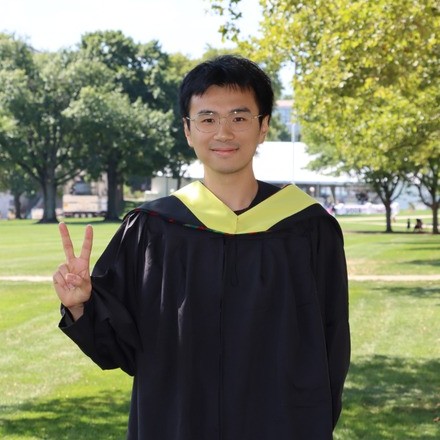
Hi! I am Kaizhen Tan, a Ph.D. student at New York University, supervised by Prof. Chenghe Guan and Prof. Zhan Guo. I received my master’s degree in Artificial Intelligence at Carnegie Mellon University and bachelor’s degree in Information Systems from Tongji University.
My research sits at the intersection of Urban Science and Embodied AI. Driven by the vision of harmonizing artificial intelligence with urban ecosystems, I aim to address the knowledge-to-action gap in digital cities: while urban digital systems are increasingly capable of monitoring conditions, modeling urban dynamics, and anticipating risks, they still struggle to support timely, place-based action. My work seeks to build spatially intelligent and socially aware urban AI systems that make cities more adaptive, inclusive, and governable.
Methods: Geospatial & Spatiotemporal Analysis, Computational Social Science, Causal Inference, Agent-Based Simulation, Digital Twins, Behavioral Modeling, Multimodal Perception, Representation Learning, World Models
🤖 1. Urban Robotics & Public Space
How can robots share urban public space while preserving pedestrian access and safety?
Human-Robot Coexistence: Study how pedestrians respond to robot behavior in shared spaces.
Accessibility and Failure: Assess how robot movement and stopping positions affect sidewalk access.
Deployment and Governance: Examine how infrastructure, right-of-way rules, and retrieval responsibilities shape robot deployment.
🚀 2. Spatial Intelligence & World Models
How can AI models learn and reason about the spatial and physical structure of the world?
Spatial and Physical Reasoning: Study directional relations, metric scale, and physical constraints in vision-language models.
World Models: Examine which physical properties predictive representations recover and which remain unidentifiable.
Model Evaluation: Test spatial reasoning and geographic fidelity with controlled benchmarks.
🎨 3. Urban Perception & Geospatial Computing
How can visual and geospatial data measure urban environments and how they change?
Street-View Perception: Estimate streetscape attributes and study perceptions of urban scenes.
3D Reconstruction and Measurement: Recover scene geometry and metric dimensions from images, including sidewalk width.
GeoAI and Urban Analysis: Combine imagery with geodata to analyze spatial patterns and change.
🏙️ 4. Digital Twins & Behavioral Simulation
How can digital twins and behavioral simulations support decisions about urban space?
Pedestrian Behavior: Model variation in pedestrian responses across populations and social contexts.
Multi-Agent Simulation: Simulate interactions among pedestrians, vehicles, and robots under different street layouts.
Policy Evaluation: Compare right-of-way and deployment policies through their effects on mobility and accessibility.
🔥 News
2026.10: 🎉 Received the NeurIPS 2026 Financial Assistance Award.
2026.09: 🎉 My paper GeoFidelity-Bench was accepted to the NeurIPS 2026 Evaluations and Datasets Track.
2026.07: 🎉 Our paper CREG was accepted by the 9th Chinese Conference on Pattern Recognition and Computer Vision (PRCV 2026).
2026.03: 🎓 I am pleased to share that I will begin my PhD at New York University in Fall 2026 under the supervision of Prof. Chenghe Guan and Prof. Zhan Guo.
2026.01: 🎉 The abstract co-authored with Prof. Fan Zhang has been accepted for the XXV ISPRS Congress 2026. See you in Toronto!
2025.12: 🎉 Our paper, led by my senior labmate Dr. Weihua Huan and co-authored with Prof. Wei Huang at Tongji University, was accepted by GIScience & Remote Sensing; honored to contribute as second author and big congratulations to Dr. Huan!
2025.10: 🔭 Joined Prof. Yu Liu and Prof. Fan Zhang’s team at Peking University as a remote research assistant.
2025.08: 🎉 Delivered an oral presentation at Hong Kong Polytechnic University after our paper was accepted to the Global Smart Cities Summit cum The 4th International Conference on Urban Informatics (GSCS & ICUI 2025).
2024.04: 🔭 Began my academic journey at Prof. Wei Huang’s lab in the College of Surveying and Geo-Informatics, Tongji University.
📖 Education
New York University2026.09 – 2031.05
Ph.D. student in Urban Science · New York / Shanghai
Designing embodied-intelligence-friendly urban spaces, and advancing collaborative governance through digital twins and urban agents that model complex city dynamics.
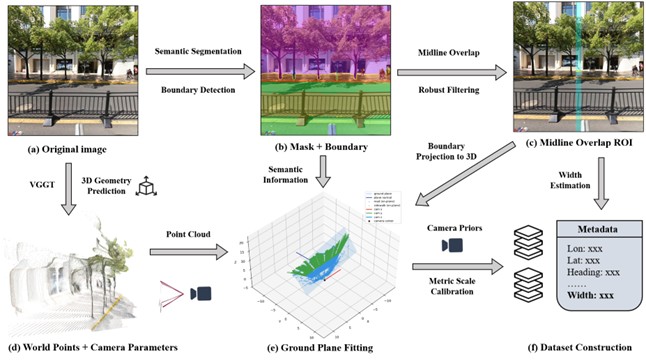
Automated urban element measurement from street view using VGGT and semantic segmentation, recovering metric scale via ground-plane fitting and camera-height calibration for large-scale data generation.
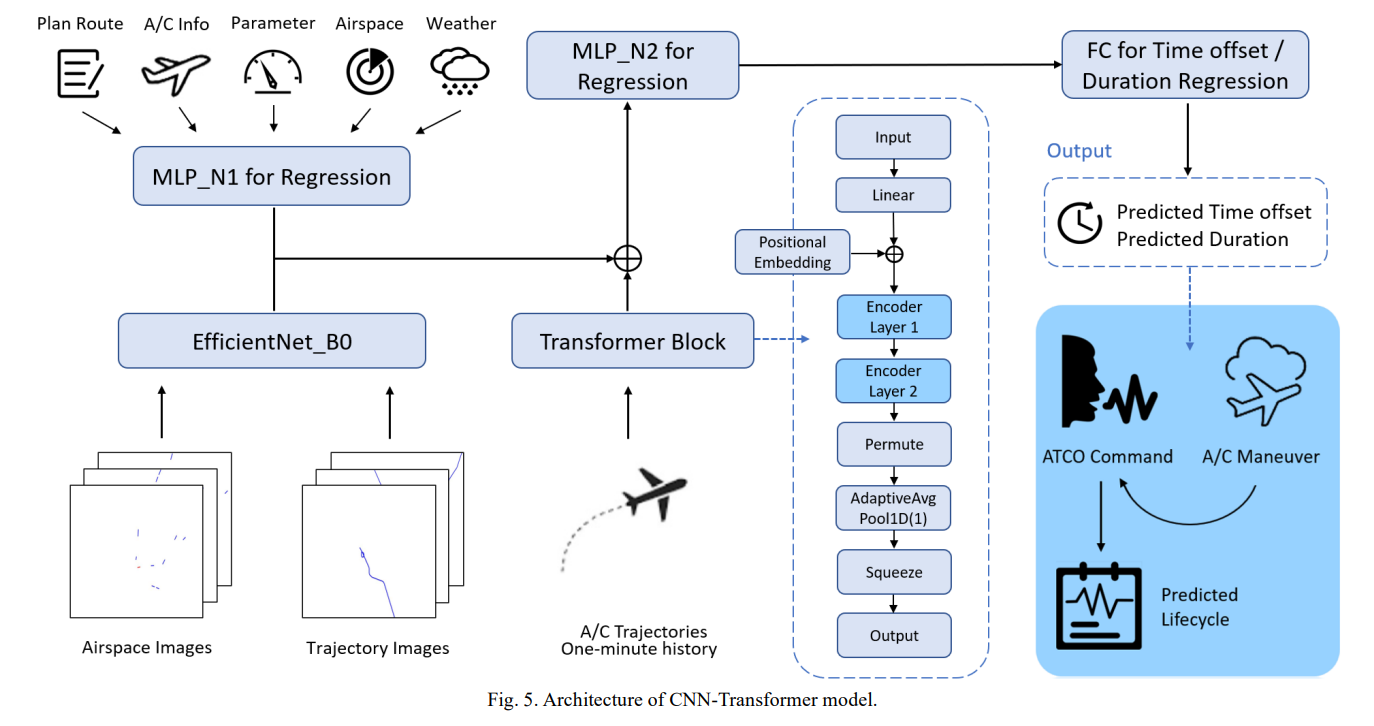
Modeled air traffic controller communication tasks to predict workload from radiotelephony and trajectory data, integrating multi-source air traffic data with a CNN-Transformer model.
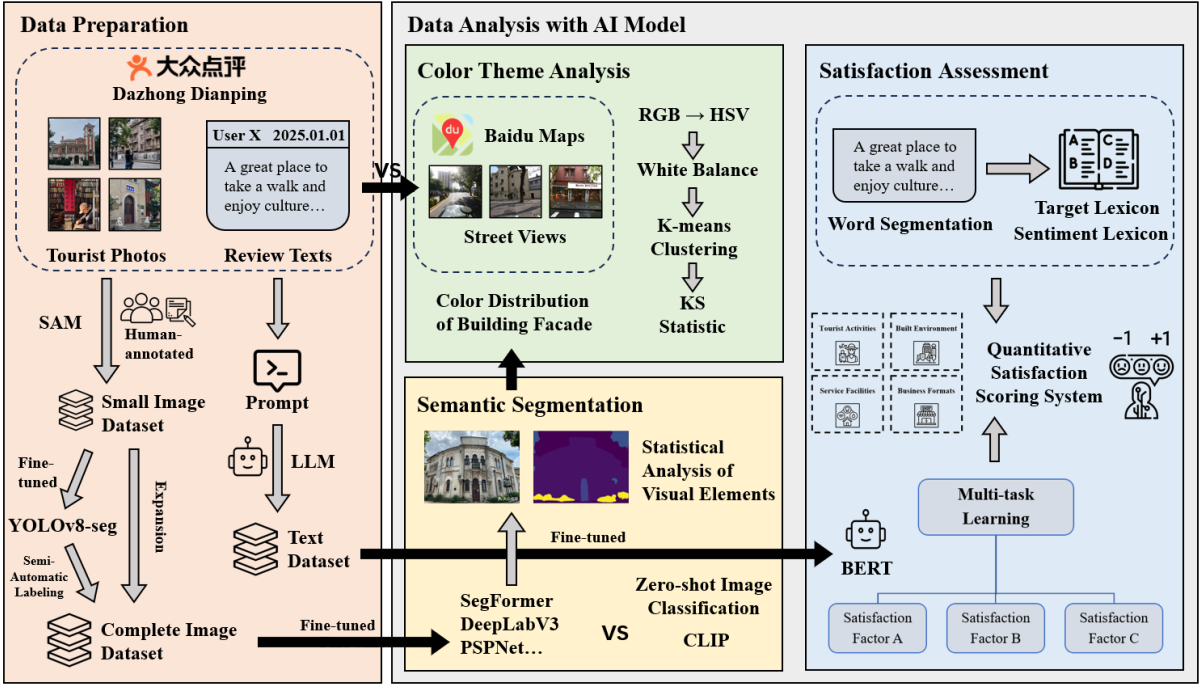
Built a multimodal pipeline over social media reviews and photos to analyze tourist perception of historic quarters, fine-tuning segmentation models and applying sentiment analysis for multi-dimension satisfaction scores.
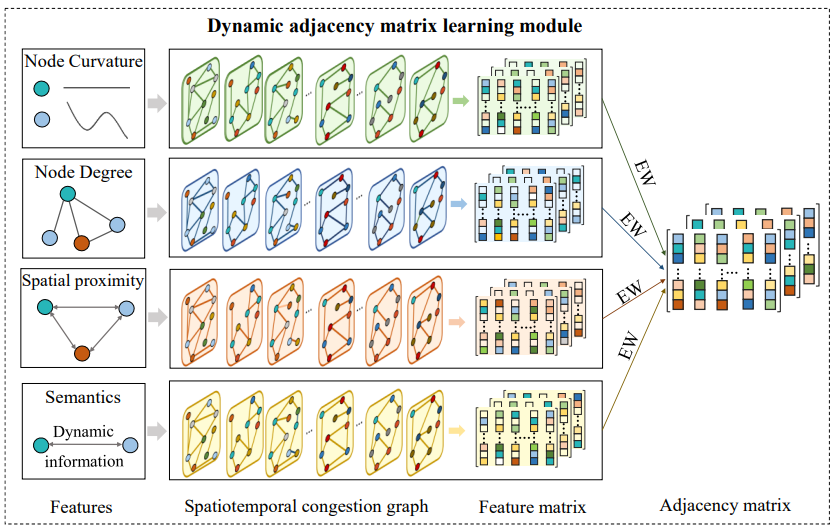
Modeled traffic congestion propagation with spatiotemporal graphs and multi-scale community search, linking propagation patterns to built environment factors via causal analysis and POI-based features.
Ran end-to-end market and competitive analysis for AI products (Migo, Auto-Research) against 50+ vertical tools, built an operational KPI dashboard for retention and behavior funnels, and established evaluation frameworks for Migo's InternLM model.
A measurement pipeline that estimates metrically scaled sidewalk width from a single street-view image through VGGT-based 3D reconstruction, semantic segmentation, and adaptive ground-plane fitting, reaching 0.25 m MAE on a Washington D.C. benchmark.
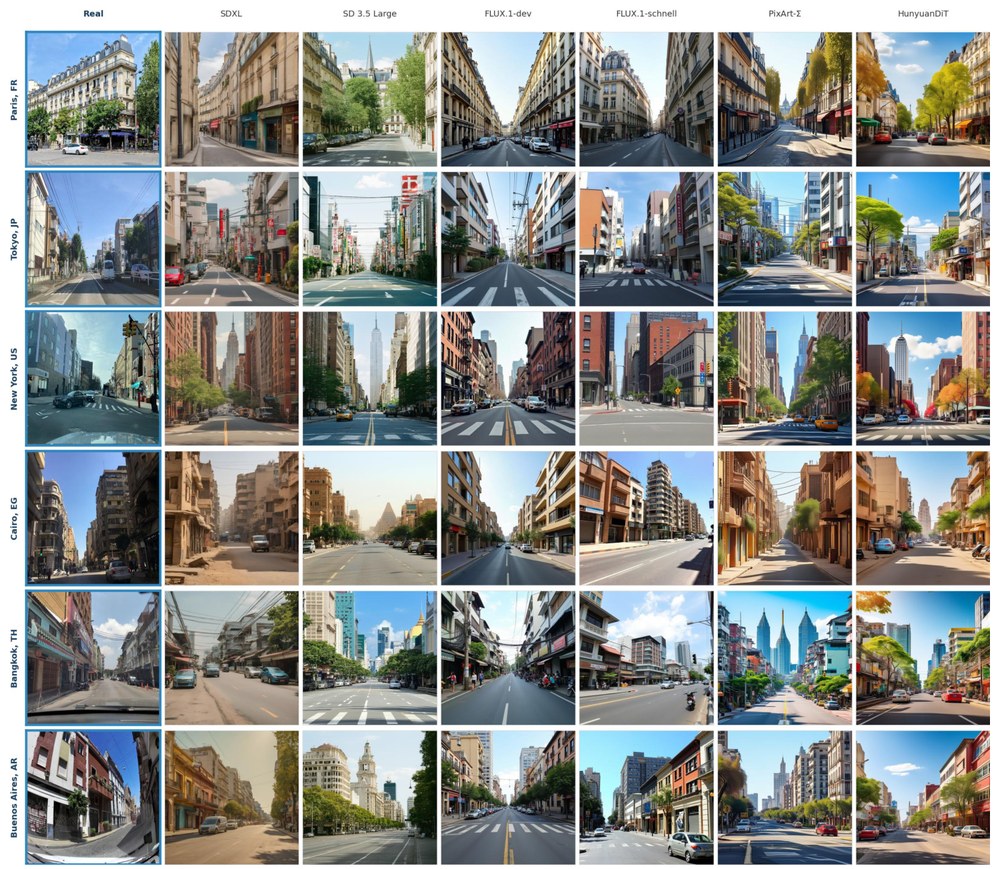
GeoFidelity-Bench: Evaluating Block-Conditioned Geographic Fidelity in Text-to-Image Street-View Generation
A benchmark spanning 112 street blocks in 25 cities across six continents evaluates how closely generated street views match their target locations. Across six open-weight models, street and neighborhood names improve geographic fidelity, while adding raw GPS coordinates yields small, uneven gains. CLIP text-image alignment provides little information about block-level geographic fidelity.
A Spatiotemporal Adaptive Local Search Method for Tracking Congestion Propagation in Dynamic Networks
A spatiotemporal adaptive local search (STALS) method combining dynamic graph learning and spatial analytics to trace how large-scale urban traffic congestion propagates through a road network.
Decoding Tourist Perception in Historic Urban Quarters with Multimodal Social Media Data: An AI-Based Framework and Evidence from Shanghai
Kaizhen Tan, Yufan Wu, Yuxuan Liu, Haoran Zeng
Global Smart Cities Summit cum The 4th International Conference on Urban Informatics (GSCS & ICUI), 2025.
A multimodal framework for reading tourist perception in historic Shanghai quarters, combining image segmentation, color theme analysis, and sentiment mining into four-dimensional satisfaction scores.
Multimodal Deep Learning for ATCO Command Lifecycle Modeling and Workload Prediction
Kaizhen Tan
7th Asia Conference on Machine Learning and Computing, 2025.
A CNN-Transformer framework linking air traffic controller voice commands to aircraft trajectories, modeling command lifecycle and workload dynamics to support command generation and scheduling in terminal airspace.
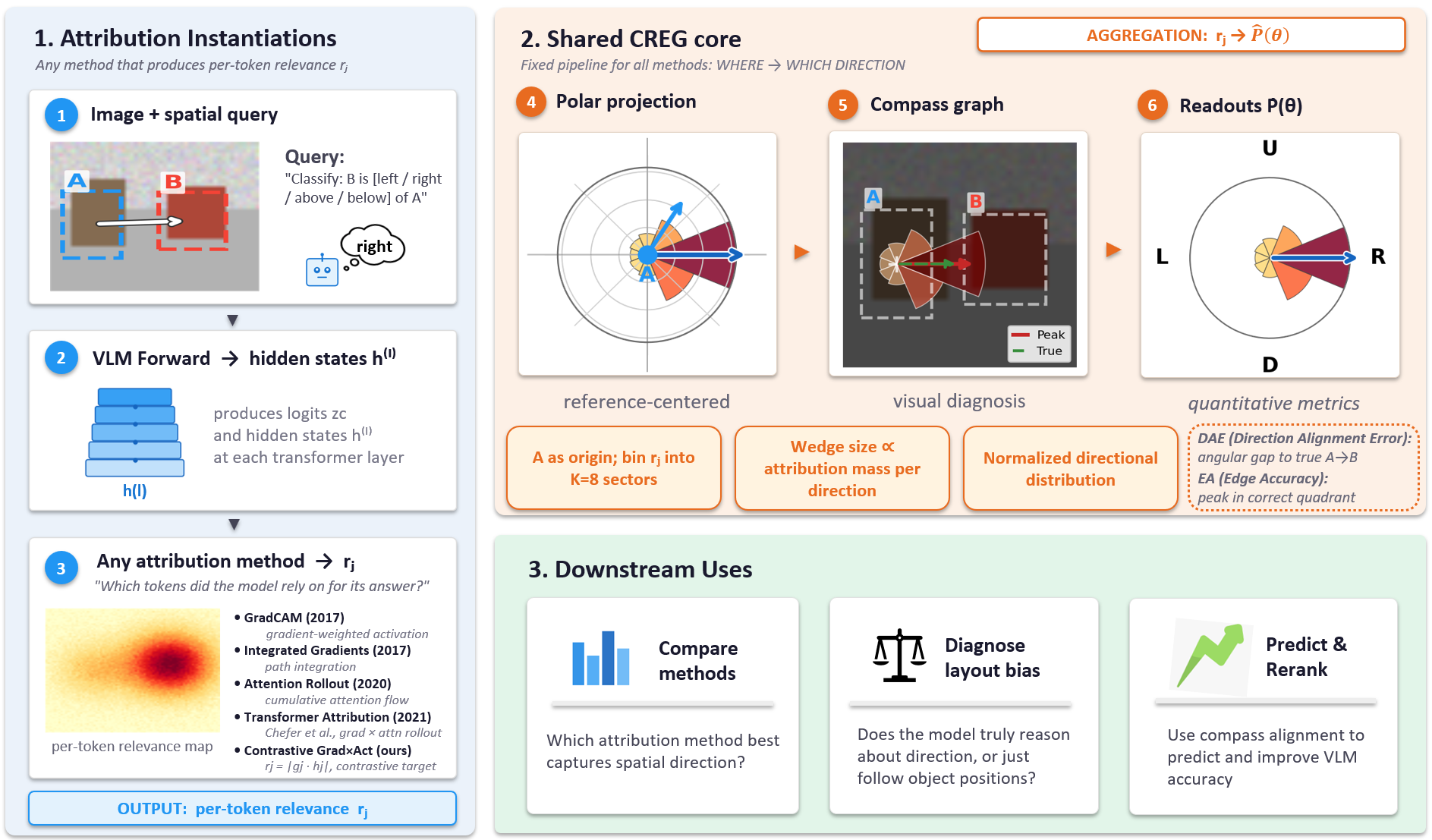
CREG: Compass Relational Evidence Graph for Characterizing Directional Structure in VLM Spatial-Reasoning Attribution
Kaizhen Tan, Yang Feng, Heqing Du
9th Chinese Conference on Pattern Recognition and Computer Vision (PRCV), 2026.
A training-free diagnostic that maps vision-language model attributions onto a compass graph, measuring whether the evidence a model attends to aligns with the queried spatial direction. Higher accuracy does not imply better directional structure.
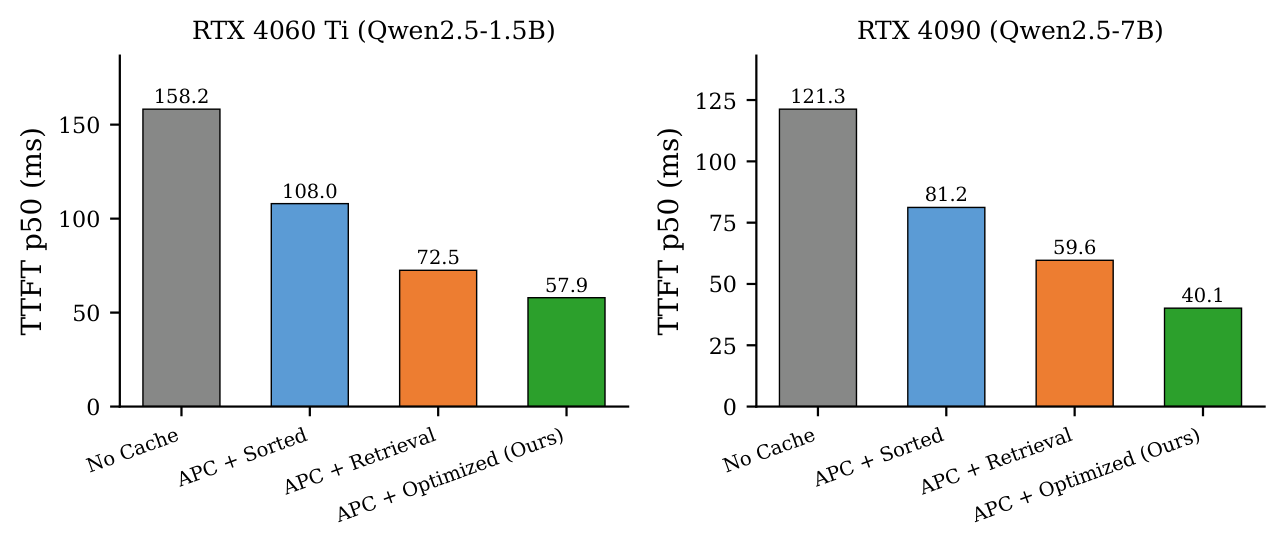
CacheWeaver: Cache-Aware Evidence Ordering for Efficient Grounded RAG Inference
A prompt-layer reordering method that rearranges retrieved evidence so overlapping passages share prefix-cache hits, cutting median time-to-first-token by 20–33% across three vLLM configurations without touching the serving engine or the evidence set.
Preprints & Under Review
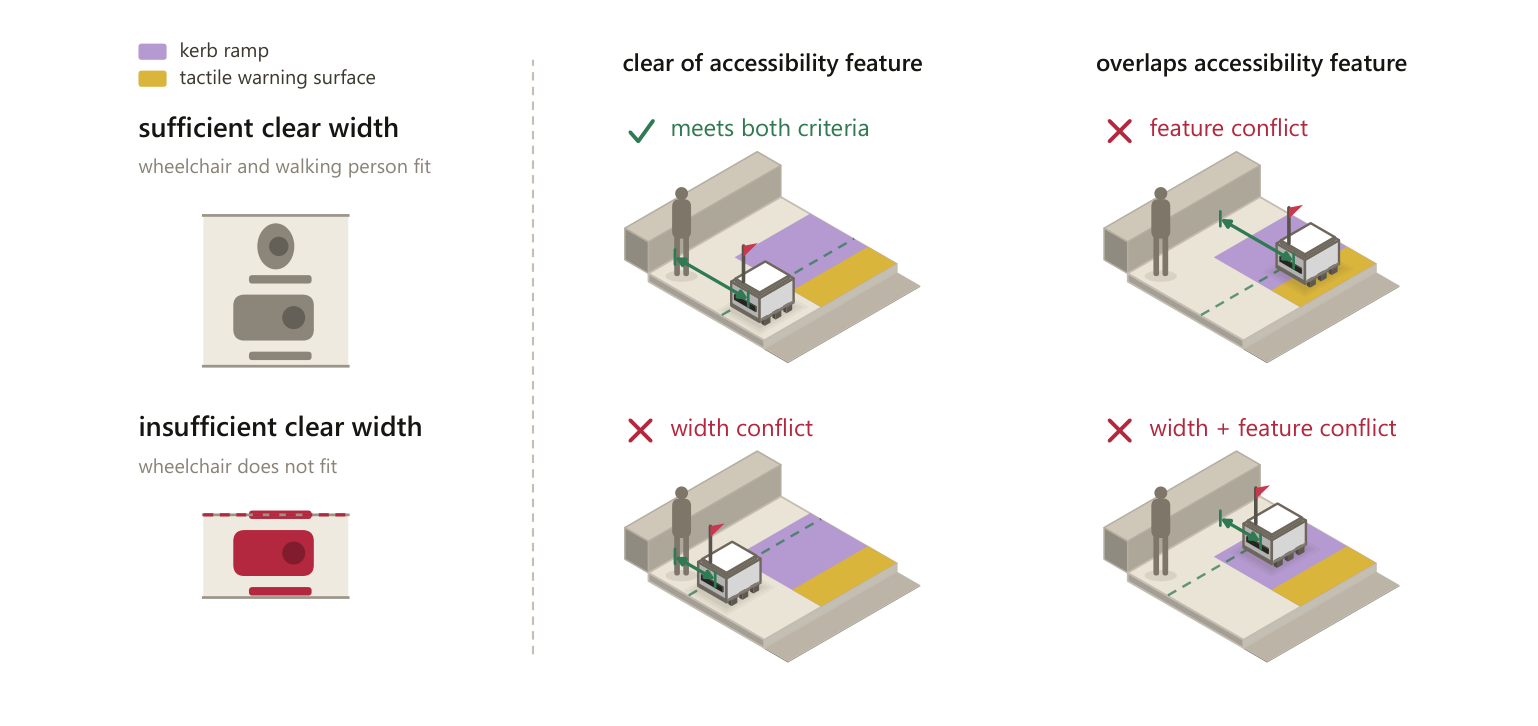
Failure Has a Footprint: Rethinking Sidewalk Robot Failure in Public Space
Kaizhen Tan, et al.
Submitted to HRI 2027.
Studies the sidewalk space occupied by failed delivery robots and its accessibility consequences. In 1,000 simulated failures on New York footways, an access-aware siting policy reduces failures below the ADA clear-width threshold from 55.7% to 18.8%.
PopNavShift: Stress-Testing Social Navigation Strategies under Population Shift
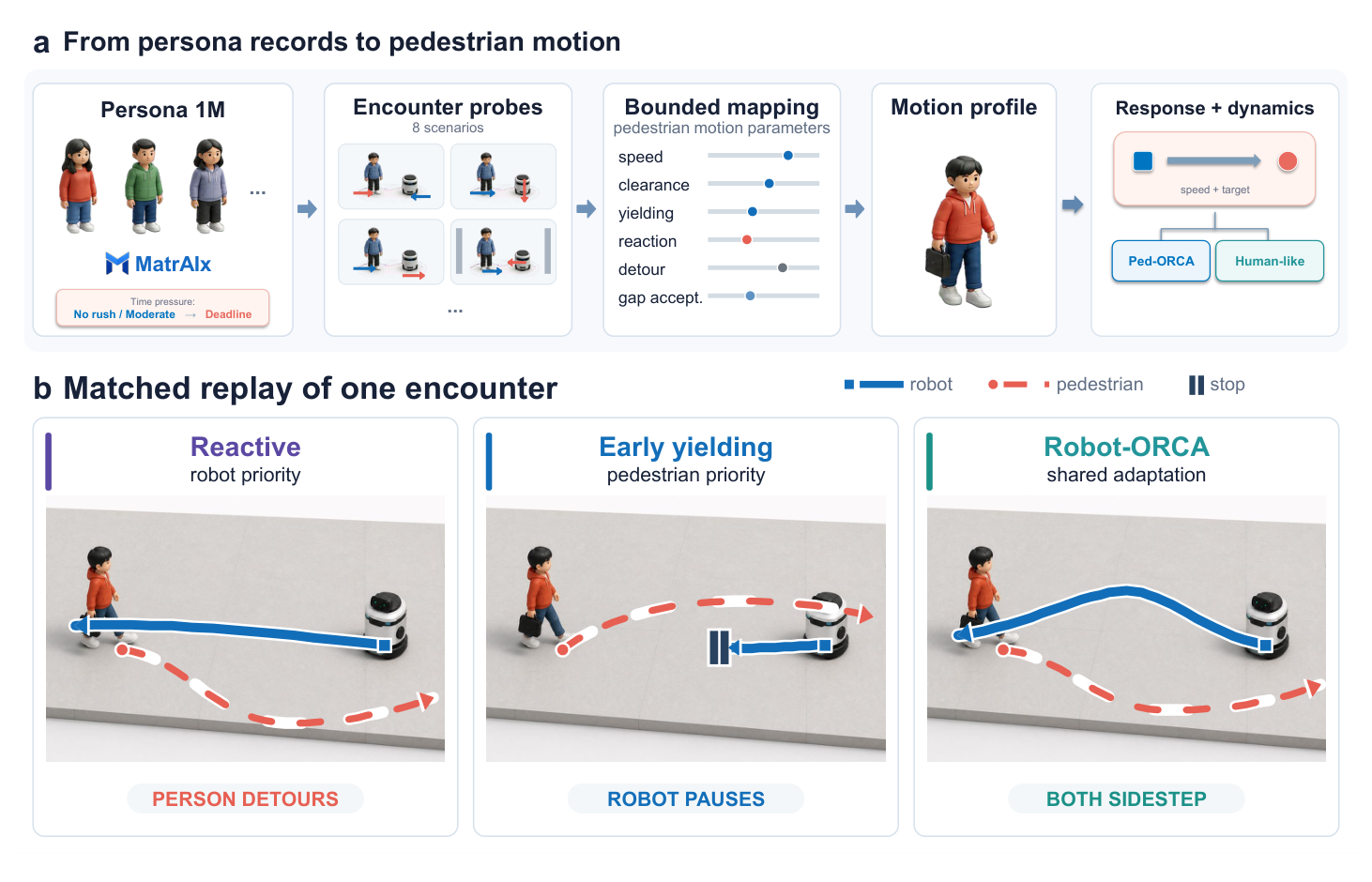
Replays identical physical episodes under different synthetic pedestrian-profile distributions to test whether robot navigation strategies keep their relative ranking. Across eight population conditions and 7,488 matched runs, changing pedestrian time pressure reverses 22.4% of mean pedestrian-delay orderings, compared with 8.6% of robot travel-time orderings.
From Robot Actions to Human Responses: What Can Public HRI Data Support?
Kaizhen Tan, et al.
Submitted to HRI 2027.
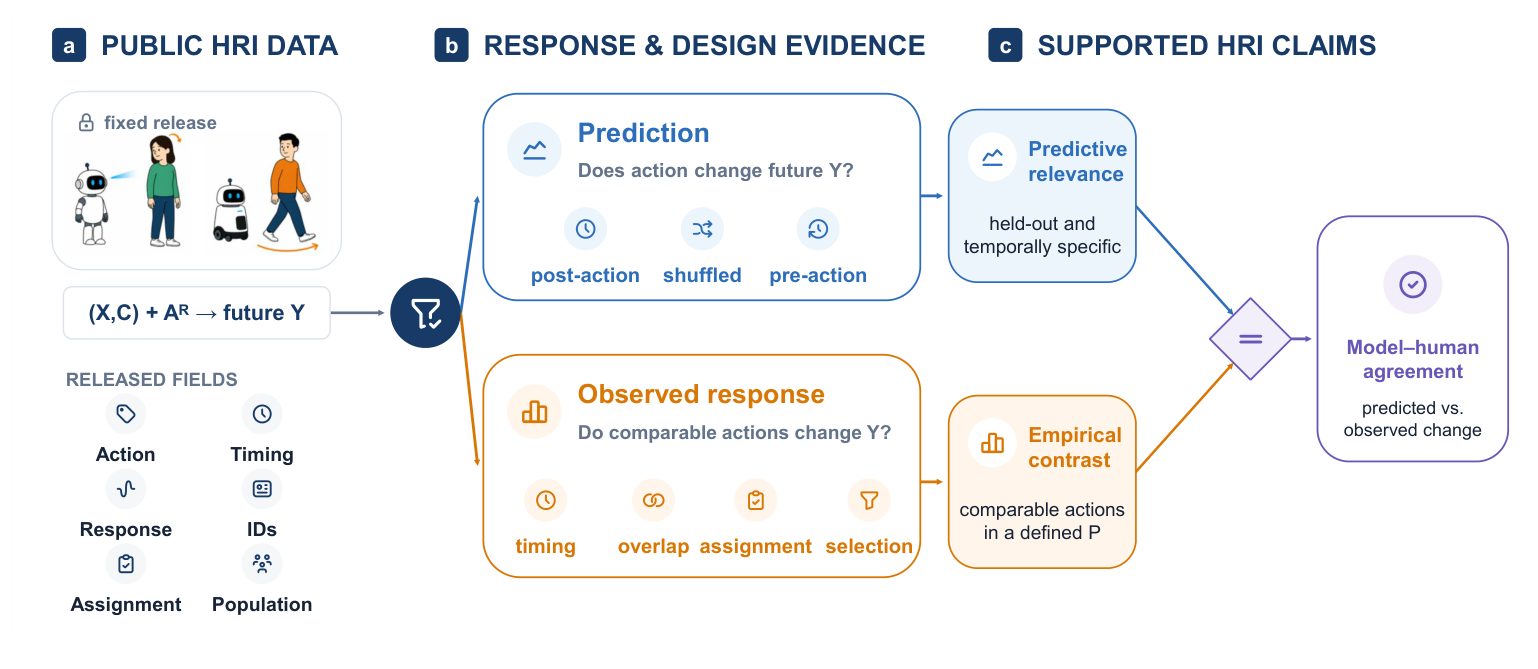
Introduces Design × Response, an evaluation method that compares the model-predicted response change between robot actions with the observed human-response change for the same action pair, response, and population. Applied to seven public HRI releases, it shows that temporal specificity, action comparability, and population alignment provide independent evidence about whether a release can support model–empirical agreement.
What Can Latent World Models Know? Physical Parameter Identifiability in Multimodal Predictive Representations
Asks which physical parameters a latent world model actually recovers in its predictive representation, and which stay structurally unidentifiable however well the model predicts.
Beyond Multimodal Alignment: Certifying Physical Language through Response Substitution and Ordered Execution
Defines physical meaning through responses to controlled interventions and introduces a certificate for testing whether sensor mappings preserve that meaning across unseen entities. On Cluster Haptic, same-surface response distances are 4.5× smaller than wrong-surface distances across all 19 test surfaces.
When Does Visual Token Pruning Improve Calibration? The Role of Evidence Coverage in MLLMs
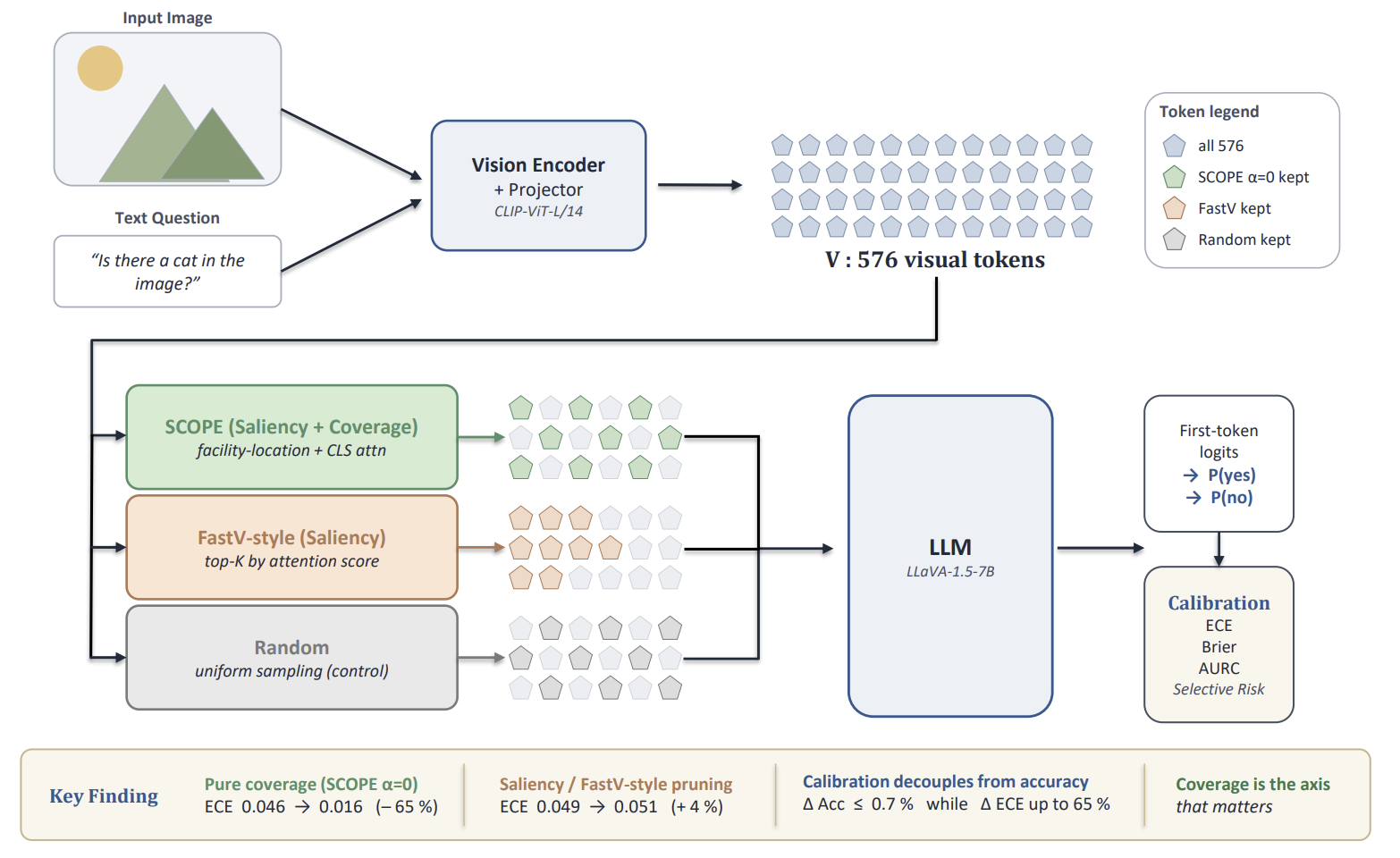
For multimodal LLM confidence, the selection rule matters more than the token budget: coverage-based pruning cuts expected calibration error on POPE with LLaVA-1.5 while holding accuracy, and the kept-set coverage tracks accuracy but not confidence.
Institutional Workflows and the Observed Geography of Metro Lost-Property Records: Evidence from Qingdao
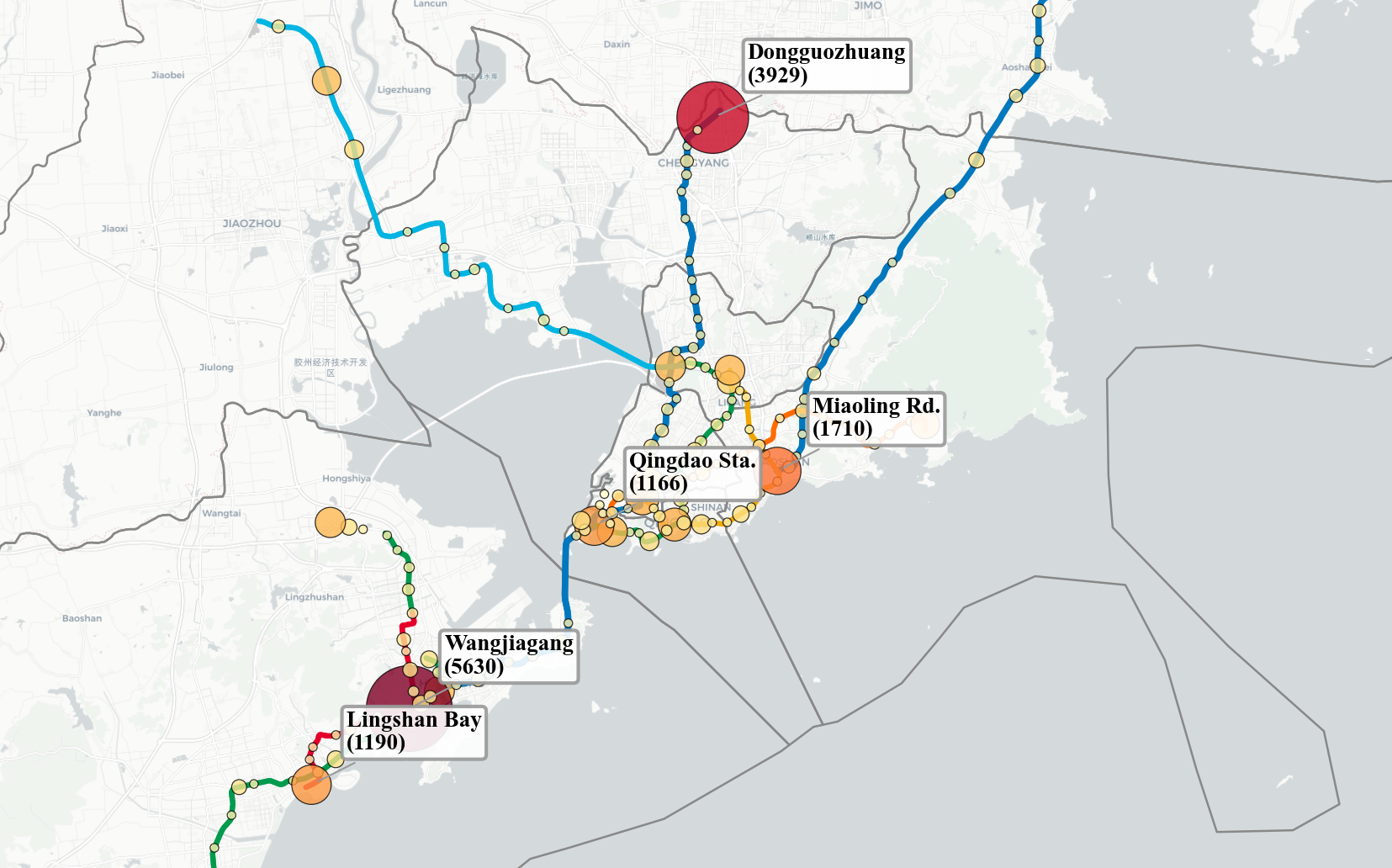
Examines 54,658 lost-property postings from the Qingdao Metro between July 2024 and July 2026 to ask where administrative records locate the events they describe. After accounting for station-area characteristics, terminal-only stations post at 8.76 times the rate of ordinary stations and terminal-plus-transfer stations at 21.15 times, consistent with recovery and attribution workflows shaping the observed geography.
Vision Models Predict Urban Scene Appraisal with Limited Neural Alignment
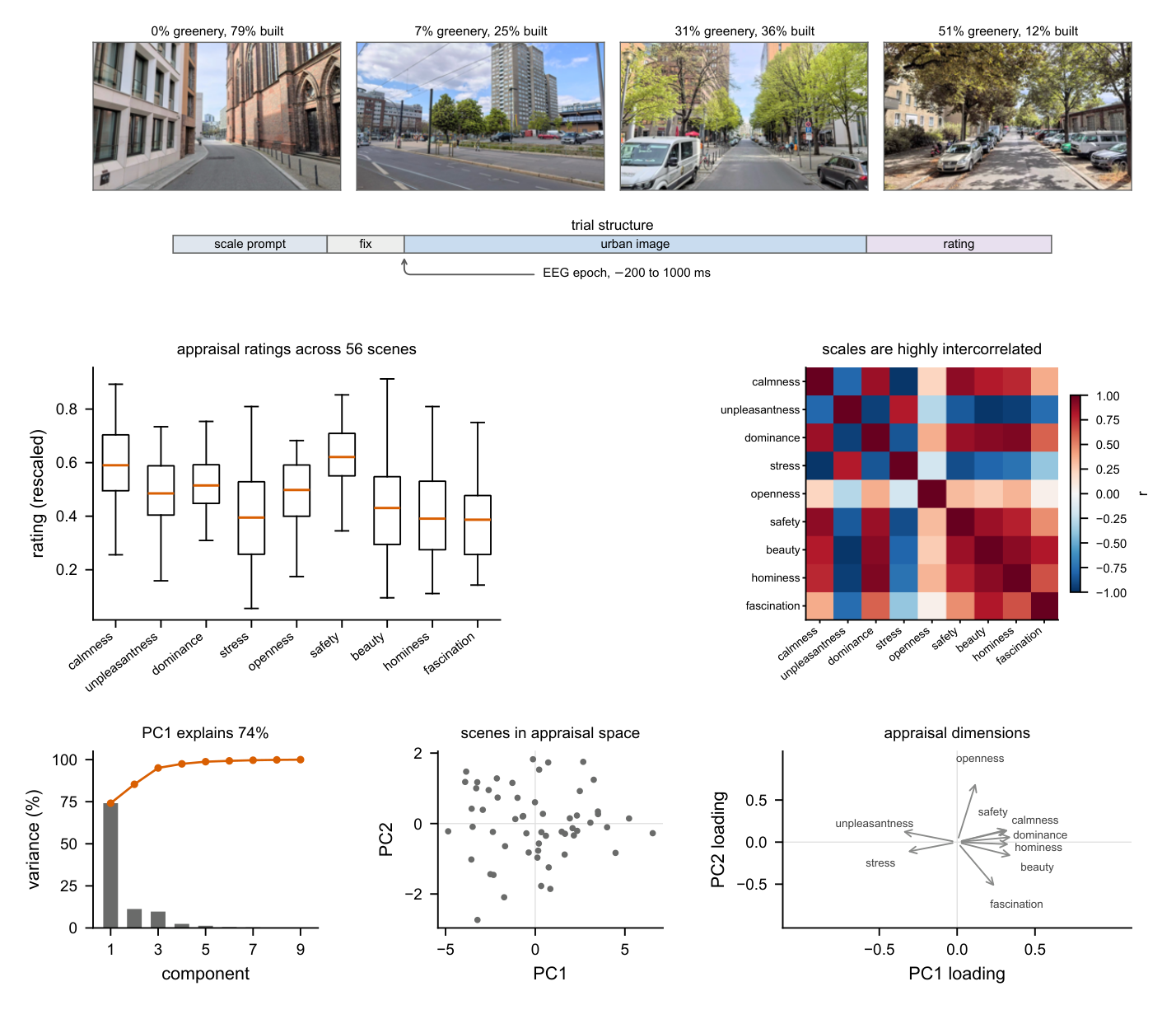
Tests predictive accuracy and neural alignment separately using EEG from 63 adults who rated 56 Berlin street scenes, across seventeen feature spaces. The best representation, DINOv2 ViT-B, reaches 29.6% of the noise-ceiling lower bound and a Gabor energy descriptor is indistinguishable from it, while the same embeddings predict held-out appraisal ratings at up to r = 0.87; the two measures do not track each other across models.
Teaching Vision-Language Models to Use the Scale They Are Given: Label-Free Equivariance Training for Metric Physical Reasoning
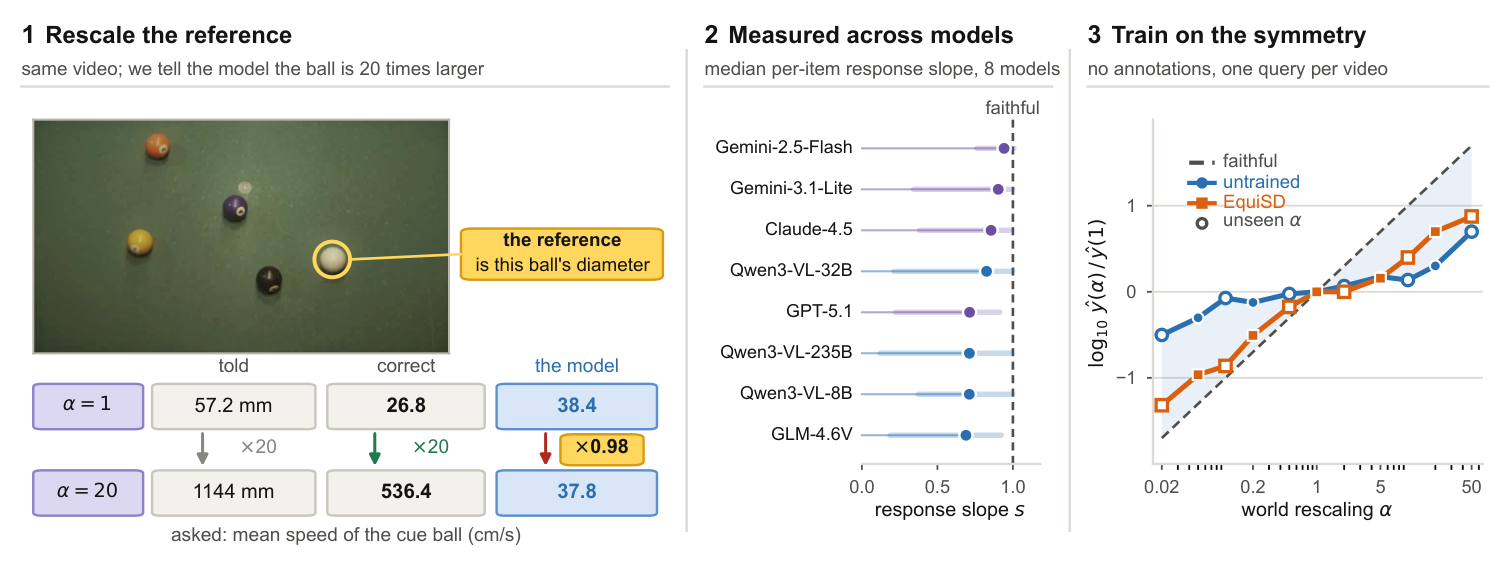
When every world-space quantity in a prompt is rescaled by a common factor, the correct metric answer changes by that factor, but eight vision-language models move only part of the way over four orders of magnitude. EquiSD uses this exact scaling relation as label-free supervision and raises a 3B model’s median response slope from 0.66 to 0.94 with one query per training video.
In Preparation
RoboROW: A Right-of-Way Simulation and Policy Toolkit for Urban Service Robots
Kaizhen Tan, et al.
Manuscript in preparation.
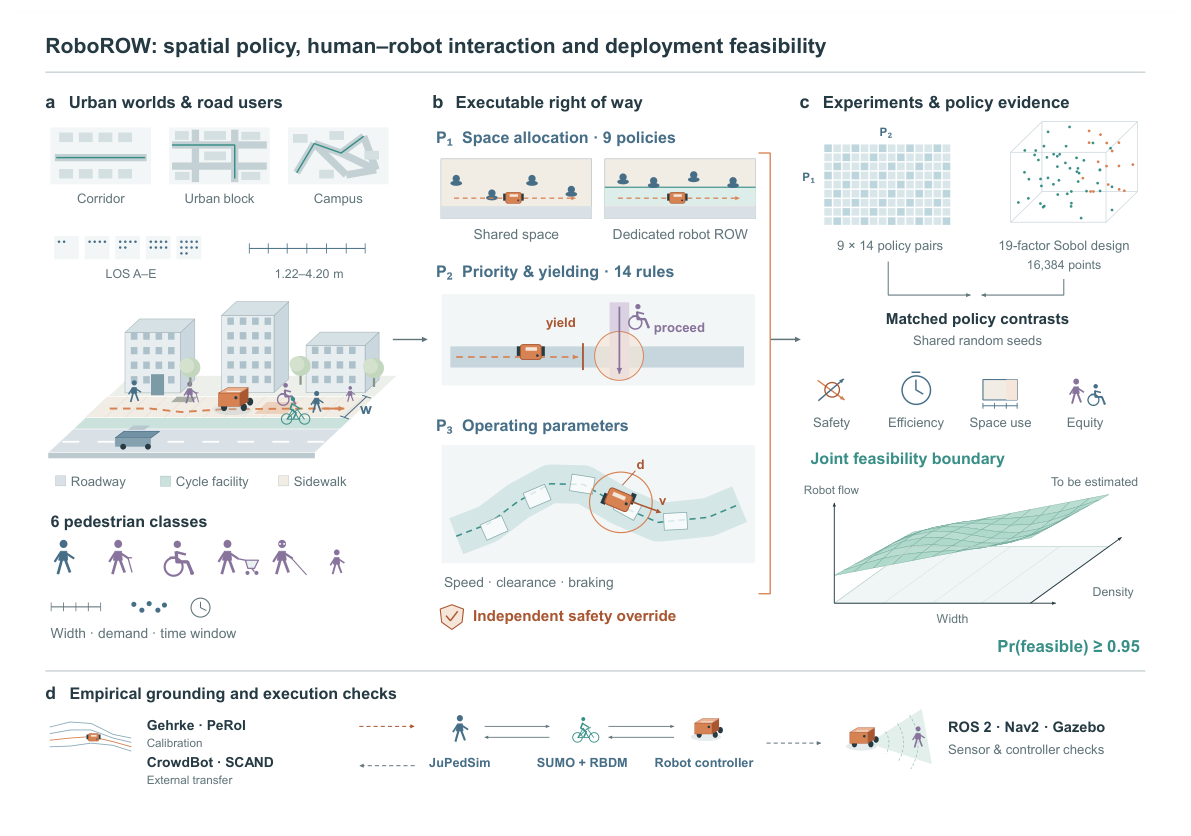
A multi-agent co-simulation toolkit that translates robot right-of-way policies into spatial access, priority, motion, and safety rules across pedestrian, traffic, and robot simulators. It evaluates alternative spatial-allocation and priority policies under varying street geometry and pedestrian demand to estimate deployment-feasibility boundaries.
Robotic Urbanization and the Transformation of Urban Ground Transportation Systems: An Updated Review
Kaizhen Tan, et al.
Manuscript in preparation.
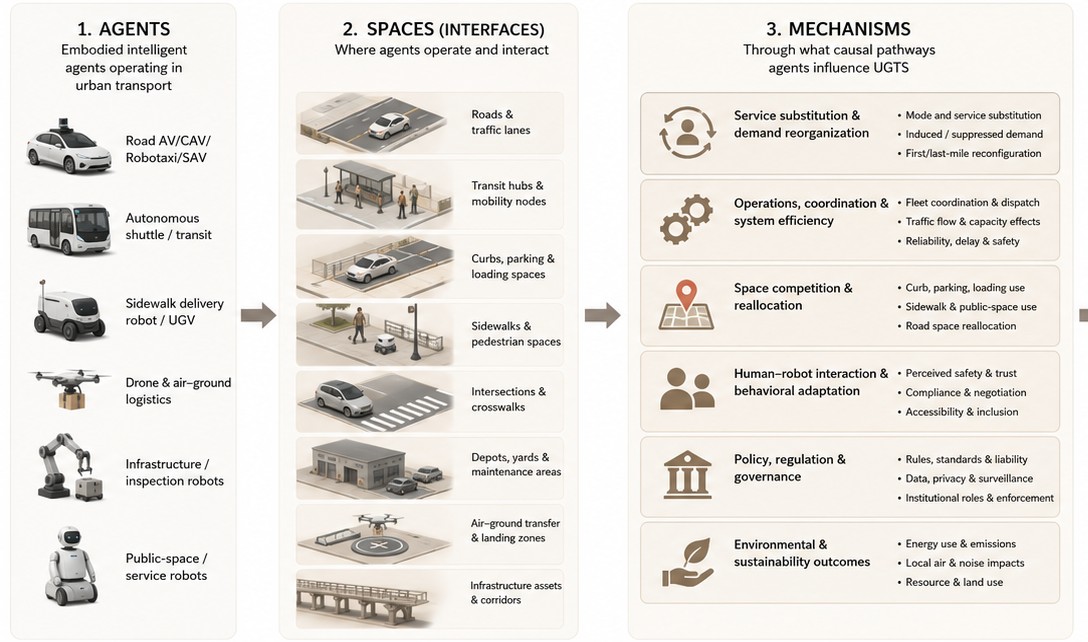
A systematic mapping review of 347 studies on robotic urbanization from 2017 to 2026. Road automation accounts for 88.5% of primary agent codes, while the Agent-Space-Mechanism-Outcome framework synthesizes how robots move through and interact with urban spaces and people.
Legal Classification and the Morphological Selectivity of Delivery Robot Deployment: Comparing China and the United States
Kaizhen Tan
Manuscript in preparation.
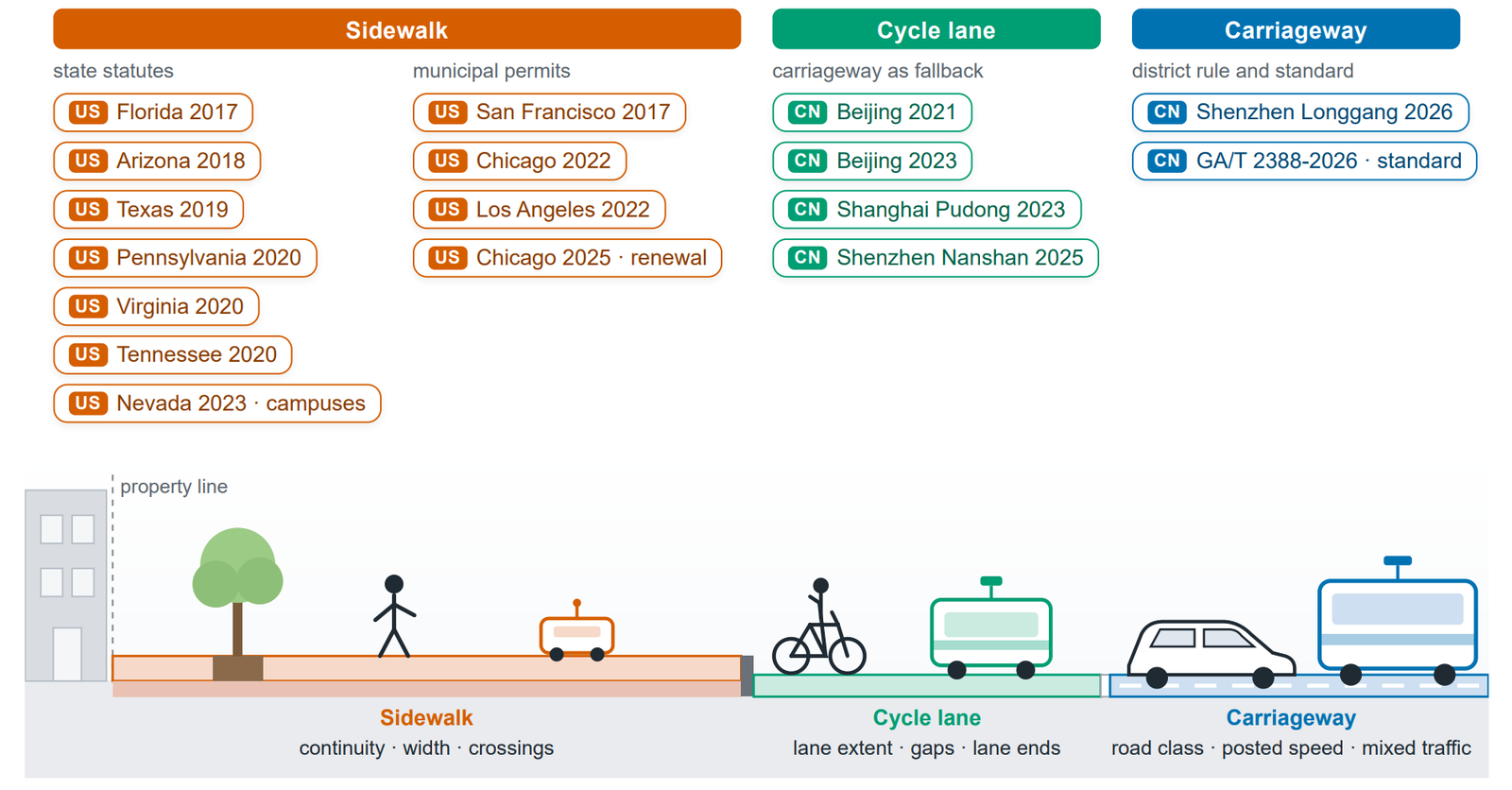
Compares 21 delivery-robot regulations in China and the United States by whether robots are assigned to sidewalks, cycle lanes, or carriageways. Rule-based network analysis shows that the same 0.60 m robot completes 83% of sampled trips under Beijing’s carriageway rule but 33% under Pennsylvania’s sidewalk rule.
Seeing the City or Recognizing the Place? What Street-View Imagery Adds Beyond Existing Urban Data in VLM Urban Sensing
Kaizhen Tan, et al.
Manuscript in preparation.
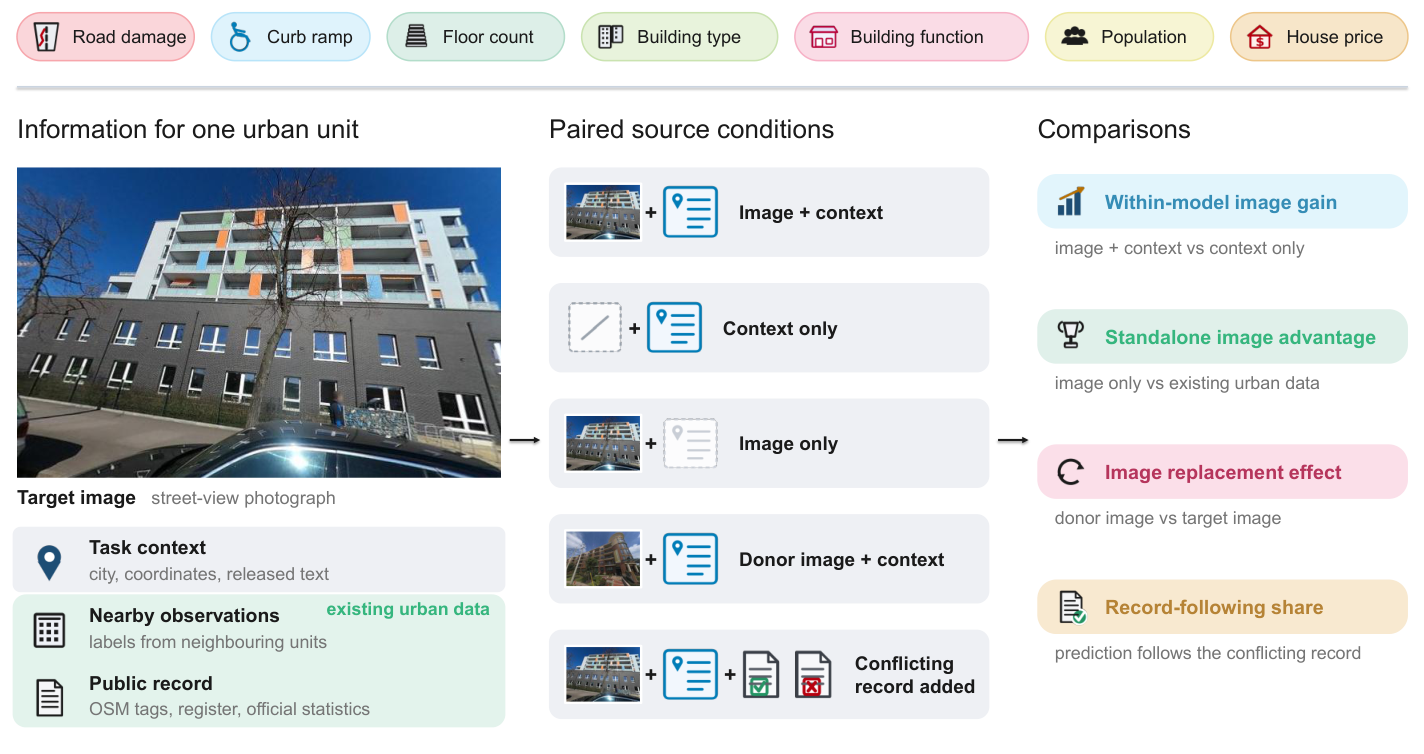
Compares street-view imagery with existing urban data across seven attributes and three VLMs. Existing data matched or outperformed image-only models for road damage, curb ramps, and house price, while imagery added more value for building type, function, and low-rise floor count.
You Cannot Photograph the Same Street Twice: Reliability Limits in Vision–Language Measurement of Urban Change
Kaizhen Tan, et al.
Manuscript in preparation.
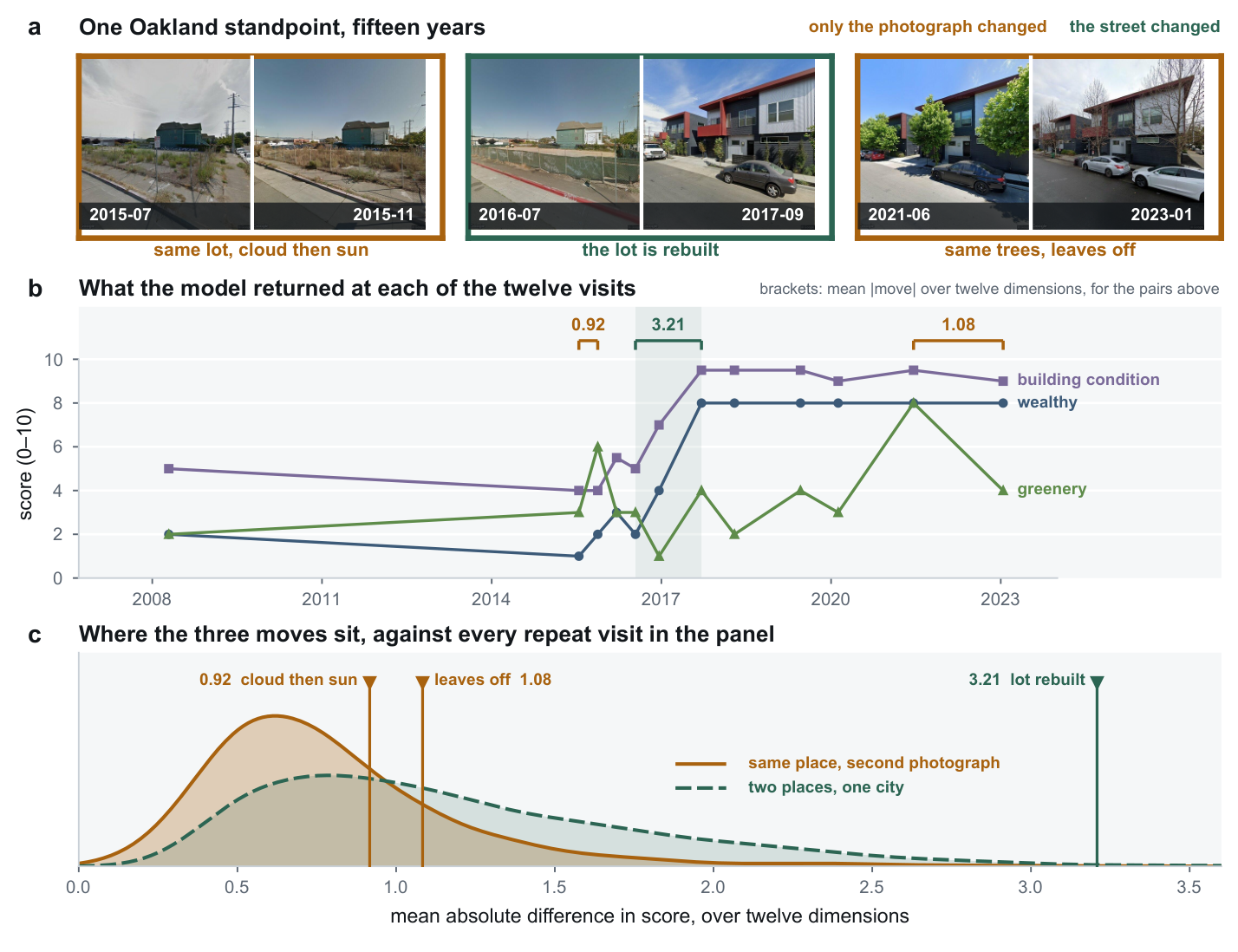
Uses 4,648 consecutive-epoch Google Street View pairs from 435 standpoints in five US cities to measure how much a VLM perception score changes when the street itself does not. Re-photographing the same street moves a score by 0.80 points on average, equal to 66.5% of the difference between two streets in the same city, while aggregation over hundreds of pairs still recovers a coherent redevelopment signal.
Technical Reports
BlindNav: YOLO+LLM for Real-Time Navigation Assistance for Blind Users
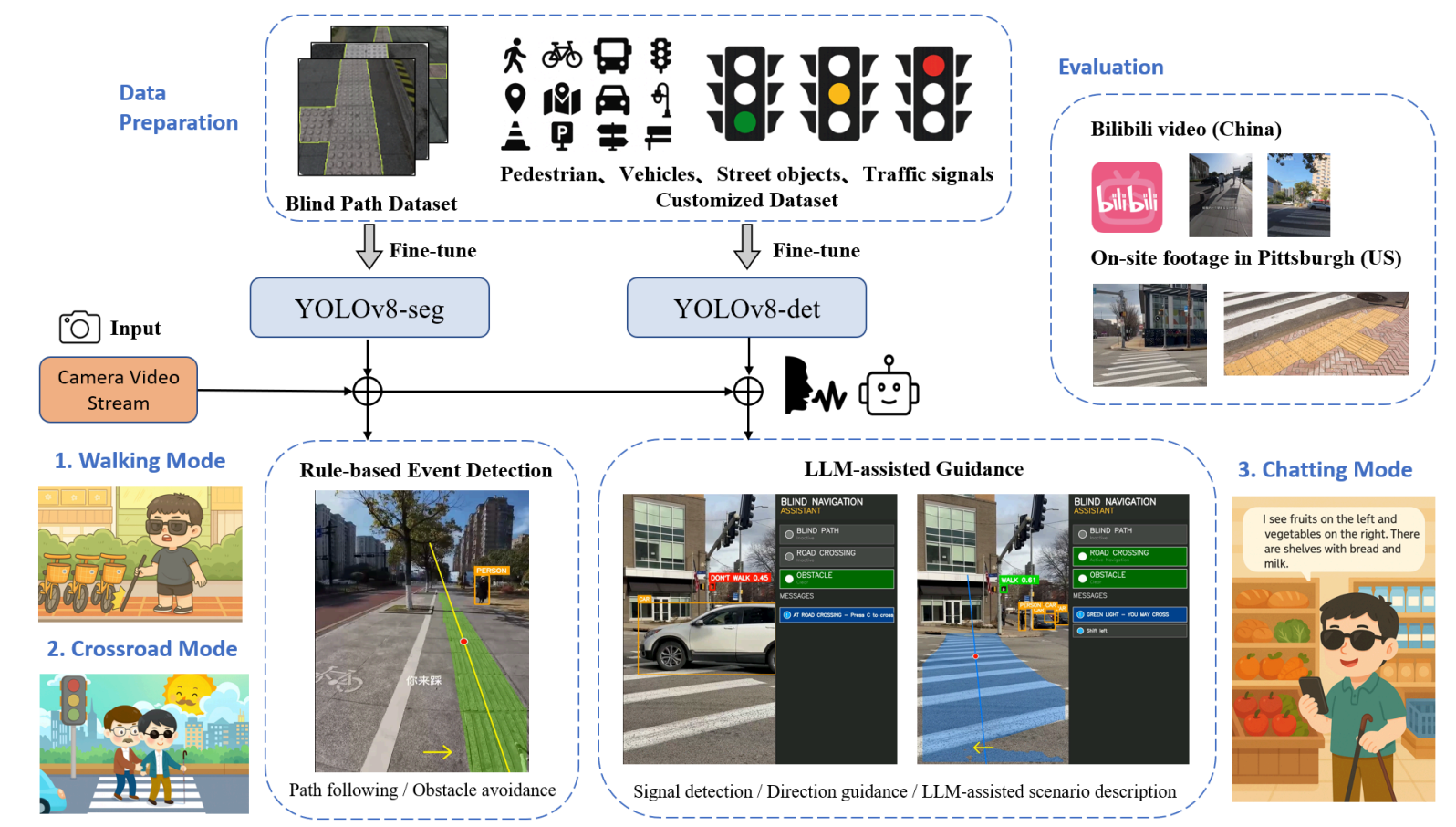
BlindNav is a real-time, camera-based navigation assistant that uses YOLO for street-scene detection and a local LLM to turn those signals into concise voice guidance for blind and low-vision pedestrians.
No publications in this direction yet.
💬 Presentations
2026.07 - XXV ISPRS Congress 2026
UrbanVGGT: Scalable Sidewalk Width Estimation from Street View Images Toronto, Canada
2025.08 - Global Smart Cities Summit cum The 4th International Conference on Urban Informatics (GSCS & ICUI 2025)
Decoding Tourist Perception in Historic Urban Quarters with Multimodal Social Media Data: An AI-Based Framework and Evidence from Shanghai Hong Kong Polytechnic University (PolyU), Hong Kong SAR, China
2025.07 - 7th Asia Conference on Machine Learning and Computing (ACMLC 2025)
Multimodal Deep Learning for ATCO Command Lifecycle Modeling and Workload Prediction Hong Kong SAR, China
🤝 Community Services
Conference Reviewing
2027AAAI Conference on Artificial Intelligence (AAAI)
2026Conference on Neural Information Processing Systems (NeurIPS)
📫 Contact
Email(NYU): kt3275@nyu.edu
Email(CMU): kaizhent@cmu.edu
Please feel free to reach out if any of these research directions resonate with you. I'd be happy to chat!
 Xiaohongshu
 ORCID
ORCID